In short
- Colorado’s Department of Law adopted the final rules under SB 26-189, 4 CCR 904-6, on November 19, 2026. They take effect 20 days after publication; the statute takes effect January 1, 2027.
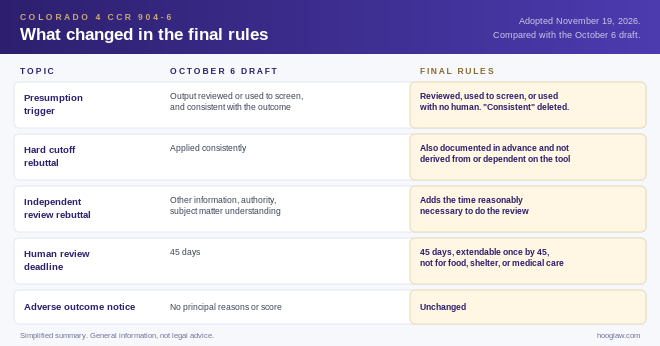
- An adverse outcome notice still doesn’t have to give the principal reasons or the score.
- A score or ranking about a person is presumed to materially influence a consequential decision if it’s reviewed, used to screen what the decision maker sees, or used to decide with no human. The October condition that it match the outcome is gone.
- Two rebuttals got narrower: a hard cutoff must be documented before the decision and not derived from or dependent on the tool’s output, and independent review requires the time reasonably necessary to do it.
- Human review got more flexible: request volume and whether the outcome can be put on hold now count toward whether review is commercially reasonable, and the 45-day deadline can be extended once, by up to 45 days, under conditions that rule it out for food, shelter, or required medical care.
Source: the adopted rules, 4 CCR 904-6 (shown as a redline), on the Colorado Attorney General’s rulemaking page.
On November 19 the Colorado Department of Law adopted its rules implementing the ADMT Act (SB 24-205, as amended by SB 26-189) and the Chatbot Safety Act, 4 CCR 904-6. For now, they aren’t in force. Before the rules go to the Secretary of State, the Attorney General has to issue a formal opinion, which the Department has requested, and they take effect 20 days after publication. The statute takes effect January 1, 2027 regardless.
I’ve written about each draft as it came out, so this piece is short: the few changes that affect how businesses will have to comply, then what the law and rules require. What a company should do about it is the subject of a companion piece, “’Not Covered’ Is Something You Prove.”
What changed
For businesses, the biggest relief came on October 6 and held. That draft dropped the requirement that an adverse outcome notice give the “principal reasons” for the decision, along with any score or inference behind it. A consumer can still get the score by requesting their personal data, which includes it. The notice doesn’t have to give the principal reasons, but a consumer who asks for human review gets the reviewer’s reasons and the factors the reviewer considered.
On coverage, the Department went the other way. In October, a score or ranking about a person was presumed to have materially influenced a decision only if the decision maker reviewed it or it screened what they saw, and the output was “consistent with the outcome.” Industry commenters attacked that last condition, since an output matching the result doesn’t prove it caused the result. The Department deleted it. Then it added a trigger of its own: an output used to make the decision with no human involved. So a recruiter who looks at a match score and hires someone else is now inside the presumption, although deciding against the output is still evidence that can rebut it.
Two of the listed ways to rebut the presumption got narrower. A hard cutoff now has to have been documented before the decision and can’t be derived from, calculated by, or dependent on the tool’s output. Independent review now requires that the person deciding had the time reasonably necessary to do it, which will be hard to show for a recruiter clearing hundreds of ranked applicants a week. Time isn’t a new consideration: the October draft listed it as a factor in judging whether an output was de minimis. The final rules dropped it there and made it a required element of this rebuttal. The Department did add that all relevant evidence must be considered, and that having or lacking any one example doesn’t, on its own, rule out a finding that the output was a de minimis factor.
Human review, on the other hand, mostly moved in the deployer’s favor. Whether review is commercially reasonable now turns on factors a deployer “may” consider, among them request volume and whether the outcome can be put on hold. If multiple consumers challenge decisions made with the same tool, configured the same way, applying the same criteria, and considering the same categories of personal data, a deployer may support a decision to decline review with evidence that it conducted human review of a randomly selected sample large enough to show more evidence wouldn’t change the outcome. The 45-day deadline to complete human review may be extended once, by up to 45 days, if the outcome is on hold and the delay won’t materially harm the consumer, among other conditions, but not for decisions affecting food, shelter, or required medical care. Not every change cut the deployer’s way, though. Reconsideration using corrected data is now presumed commercially reasonable when it means re-running the same tool, the 10-day acknowledgment has to say whether the deployer considers review commercially reasonable, and the deployer still bears the burden of proving it isn’t.
What the law and rules require
Strip away the definitions and the law asks one question about each decision: did automated decision-making technology make or materially influence a consequential decision about an identifiable individual? The question is asked decision by decision, but most of the answer is set in advance by what the tool does, what kind of decision it’s used for, and how the process around it is built, so most businesses can predict whether most of their decisions are covered. Taken a piece at a time:
- Automated decision-making technology is software that processes personal data and uses computation to produce an output, such as a score or a ranking, that is used to make a determination about a person. Among the exclusions are tools used only to summarize, organize, translate, draft, route, or present information for human review of administrative processing.
- A consequential decision is one in an area the statute lists, among them employment, housing, lending, education, and health care, that is reasonably likely to affect a person’s access to or eligibility for an opportunity there. In the rules’ examples, hiring, a promotion, a loan, admission to a program, and a financial aid award all qualify. Assigning a student to one of several identical biology sections doesn’t.
- An identifiable individual means the decision is about a particular person. The rules’ presumption of material influence applies only to an output that pertains to that person. In the statute that person is a “consumer,” a term that means a Colorado resident acting in an individual or household context and also includes employees, Colorado-resident job applicants, and anyone whose access to, eligibility for, or opportunity in Colorado is evaluated in a consequential decision by a business operating here.
- Make or materially influence is where most of the disputes will be. When a tool’s output is used to decide with no human involved, the rules presume material influence. Material influence means the output was more than a de minimis factor and affected the outcome. Under the presumption described above, a business that reviewed a score or ranking about the person, used it to screen what it saw, or let it decide without a human has to rebut the presumption.
If the answer is yes, the business that made the decision is a deployer for that decision, and the duties below attach. Even with a vendor in the middle, they stay put. When a vendor runs the tool for the business or at its direction, and the business decides using the output, Rule 4.3 leaves the business responsible, though it may contract with the vendor for help.
For a covered decision, the mechanics run in this order:
- Before the decision, the statute requires notice that automated decision-making technology will be used. Rule 3.2 requires that notice, like every other one, to be in plain language and to reach the person through the channels and languages the business already uses with them.
- After an adverse outcome, the deployer has 30 days to send a written notice describing the decision and the tool’s specific role in it, including any human reviewer’s part. If the denial was automatic, the notice says so. It also carries a link for more information and an explanation of the consumer’s rights, but it doesn’t have to give the principal reasons or the score. In the rules’ examples, an automatic-denial notice also names the factor, such as an income above the program limit. Where the Fair Credit Reporting Act or the Equal Credit Opportunity Act already requires an adverse action notice, that notice satisfies the rule if it, or a supplement sent the same way at the same time, adds the process for requesting more information and the explanation of the consumer’s rights.
- Asked for more information, the deployer has 15 days to identify the tool and its developer and describe the categories of personal data used, inferences included, naming each source it knows. No identity verification can be required for this request.
- On request, the consumer gets instructions for obtaining and correcting the personal data used in the decision. A deployer that holds the data has 45 days, extendable once by another 45, to hand it over (the score included) or fix factual errors. Scores and opinions don’t have to be corrected. If a third party holds the data, the deployer has 15 days to tell the consumer who has it and how to reach them.
- The consumer can also ask for meaningful human review and reconsideration, to the extent commercially reasonable. Within 10 days the deployer confirms receipt; within 45 it responds with the reviewer’s decision and the reasons for it. The reviewer needs authority to change the outcome; training in accuracy and objectivity, in what the tool considers and in the subject matter; access to the evidence; and protection from management pressure and retaliation. The deployer carries the burden of showing, with specific evidence, that review isn’t commercially reasonable.
People need a way to make these requests. An email address is enough for a business that deals with consumers only online and directly. Everyone else designates at least two methods, one through the website or app if there is one. Nobody can be made to open a new account to ask, and retaliating against someone for asking is prohibited.
Human-review records and developer disclosures are kept for three years, and for human review the rules spell out what the record has to show.
Upstream, developers owe deployers documentation on intended uses, known risks, training data, and how to monitor and review the tool. Handing it over, a provision added in the final rules says, doesn’t by itself establish that the tool materially influenced a decision, or that any use of it is a consequential decision.
Enforcement
Only the Attorney General can enforce the ADMT Act. A violation is a deceptive trade practice under the Colorado Consumer Protection Act, and no one else can sue under the Act. A consumer who thinks a business got it wrong can file a complaint with the Attorney General’s office, but the case is the Attorney General’s to bring. Until January 1, 2030, the Attorney General generally has to give a business 60 days to fix a violation first, unless the violation was knowing or repeated.
No private right under the ADMT Act doesn’t mean no claim. The statute says it doesn’t limit or reduce any existing right under state or federal law. If a scoring tool helped screen someone out because of race, sex, age, disability, or another protected trait, that person can still bring the claim they always could, under the Colorado Anti-Discrimination Act, Title VII, or Title IX. The statute adds that a business can be held liable under Colorado’s anti-discrimination law for a decision its tool materially influenced, and that using the tool is no defense.
Timing
A federal stipulated order in X.AI LLC v. Weiser bars the Attorney General from enforcing against conduct that occurs through 14 days after the court rules on xAI’s preliminary injunction motion. xAI has to file that motion within 28 days after “final adoption” of the rules. If the November 19 adoption starts the clock, the motion is due by December 17; if filing or publication starts it, later. Several commenters asked for a grace period. None was written in. In its place is the Attorney General’s stated policy, in the Department’s October 6 cover letter, of focusing on egregious and intentional violations and exercising “appropriate discretion” while businesses come into compliance. That policy binds no one, and the Attorney General who made it leaves office in January. For how the order works, see Colorado’s AI law after the October 26 hearing.
The same rules implement the Chatbot Safety Act. Its obligations fall on chatbot operators, and I’ll cover them separately.
If you use software that scores or ranks people for any of these decisions and aren’t sure where it falls, get in touch, or see how I handle AI governance and compliance work.
Common questions
When did Colorado adopt final rules under SB 26-189?
The Colorado Department of Law adopted the rules, 4 CCR 904-6, on November 19, 2026. They are not yet in effect. Before they go to the Secretary of State, the Attorney General must issue a formal opinion, and they take effect 20 days after publication. SB 26-189 itself takes effect January 1, 2027.
Does an adverse outcome notice have to give the principal reasons or the score?
No. The October 6, 2026 interim draft dropped that requirement and the final rules kept it out. Within 30 days, the notice must describe the decision and the tool’s specific role, including any human reviewer’s part, say so if the denial was automatic, and explain how to request more information and exercise the consumer’s rights. A consumer can still get their score by requesting the personal data used in the decision.
When is a score or ranking presumed to materially influence a decision?
Under the final rules, an output about the person is presumed to materially influence a consequential decision if it is reviewed by the deployer, used to screen what the deployer sees, or used to make the decision without human involvement. The October draft’s condition that the output be consistent with the outcome was deleted. The deployer can rebut the presumption with evidence that the output was only a de minimis factor.
How long does a business have to complete human review?
The deployer must confirm receipt within 10 days and complete the review and respond within 45 days. It may extend once, by up to 45 days, if the extension is reasonably necessary, the adverse outcome is on hold, and the delay won’t materially harm the consumer, among other conditions. The extension isn’t available for decisions affecting food, shelter, or required medical care.
Regulatory status as of November 24, 2026
The Colorado Attorney General adopted final rules under SB 26-189, 4 CCR 904-6, on November 19, 2026. They are not yet in effect.
Before the rules are filed with the Secretary of State, the Attorney General must issue a formal opinion, which the Department has requested. The rules take effect 20 days after they are published. SB 26-189 itself takes effect January 1, 2027.
A stipulated order in X.AI LLC v. Weiser, No. 1:26-cv-01515 (D. Colo.), bars the Attorney General from initiating enforcement for conduct occurring on or before 14 days after the court rules on xAI’s motion for a preliminary injunction, which is due within 28 days after final adoption of the rules.
General information, not legal advice. No attorney-client relationship is created by reading this page.
Legal disclaimer
This page is for general informational purposes only and does not constitute legal advice. The discussion above is a simplified summary of Colorado SB 26-189 and the Attorney General’s rules under it, 4 CCR 904-6, and is not a substitute for a complete legal analysis of your specific situation. Laws and regulations change, and the final rules, adopted November 19, 2026, are not yet in effect. To understand your actual compliance obligations, consult with qualified legal counsel. Nothing on this page creates an attorney-client relationship between you and Hoog Law or Michael Hoog.