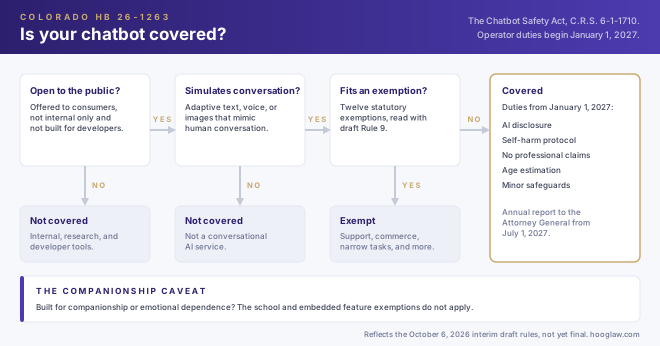
Starting January 1, 2027, a business that offers a general-purpose AI chatbot or a companion app to Colorado residents has new obligations under HB 26-1263, the Chatbot Safety Act, codified at C.R.S. § 6-1-1710. It has to tell users they are talking to AI, run a protocol for users at risk of self-harm, protect minors from sexual content and emotional dependence, and report to the Attorney General every year.
This is a separate law from SB 26-189. The ADMT law governs decisions software makes about people. The Chatbot Safety Act governs conversations software has with them. Most customer service and single-purpose bots are exempt. The businesses most likely to be caught off guard are the ones that added a branded assistant willing to talk about anything.
Who it covers
The Act applies to operators of a conversational artificial intelligence service: an AI system available to the general public that primarily simulates human conversation through text, images, or voice. There are two ways to be an operator:
- You build it and make it publicly available. The Attorney General’s draft rules count licensing it to another business as making it available.
- You offer it to consumers, even if someone else built it.
Both can apply to the same chatbot. A Colorado business that puts a licensed assistant in front of customers is an operator, and in most cases so is the vendor that built it. Neither the statute nor the draft rules divide the duties between them, so the vendor contract has to.
The protections run to Colorado residents. There is no size threshold, and the Attorney General has said the law applies to operators regardless of where they are located. Companion apps are the core target, and an app store download does not change that. The app store is not the operator; the developer is.
Who is exempt
The statute lists twelve exemptions. In practice they fall into four groups:
- Commerce and customer support. Shopping, ordering, payments, returns, and service bots.
- Narrow tasks. Order status, billing, scheduling, and menu-driven bots, as long as they cannot produce sexual content or carry on a conversation about self-harm.
- Business and internal tools. Developer and research tools, business-to-business tools, internal-only use, and device voice assistants.
- Specific settings. Video games, theme parks, HIPAA covered entities and their business associates, school tools, and features embedded in other software.
One caveat does most of the work. The school and embedded feature exemptions do not apply to anything designed to simulate emotional companionship or encourage emotional dependence. Draft Rule 9 lists what the Attorney General will look for: names, avatars, and backstories; responses built on constant validation; and memory used to create a sense of an ongoing relationship.
What it requires
The statute sets the duties. The draft rules, 4 CCR 904-6, say how the Attorney General will judge compliance. What follows reflects the interim draft released October 6, 2026; final rules are due by January 1.
- Disclose that it is AI. To every user at the start of each day’s first conversation, at least every three hours or through a persistent notice, and whenever a user asks. Minors get a persistent disclaimer that stays on screen without scrolling and stands out from the surrounding content.
- Run a self-harm protocol. A response that refers the user to a crisis line or similar service, never to law enforcement, with escalation for repeated or severe warning signs.
- Do not imply professional credentials. Advertising, the interface, and outputs cannot suggest the service comes from a licensed doctor, lawyer, mental health professional, or dietitian. Under draft Rule 13, that includes controls on bot profiles named “therapist” or “doctor.”
- Estimate users’ ages. By commercially reasonable or generally accepted methods, without ignoring clear signs that a user is a minor. Draft Rule 10 says government ID cannot be the only method, accuracy has to be tested by age band, and device and app store age signals count. So does what a user says in conversation, such as repeated references to high school. The ISO/IEC 27566-1 age assurance standard is the benchmark.
- Protect minors. No streaks, badges, or other unpredictable rewards meant to drive engagement. Technically feasible measures against sexual content, and reasonable measures against responses that simulate emotional dependence or isolation from family and friends. Draft Rule 12 treats a safeguard that depends only on the model following instructions as weak evidence, and expects testing before and after launch, with records.
- Give minors and parents control. Tools to manage privacy settings, including whether the service remembers past conversations and whether the minor’s data is used for training.
- Report every year. Beginning July 1, 2027, operators report crisis referrals, their self-harm protocols, and the metrics the Attorney General requires. Draft Rule 14 adds accuracy measures for referrals, the age distribution of users, and counts of reports involving minors. A report prepared for another state can be reused with an appendix.
The October 6 draft eased several August proposals, including how large the minors’ disclaimer must be and a requirement that minors’ settings default to the most protective option. The rulemaking is covered in more detail in Colorado’s AI law after the October 26 hearing.
How it is enforced
The Attorney General enforces the Act through the Colorado Consumer Protection Act, and a violation is a deceptive trade practice carrying civil penalties of up to $20,000 per violation. The statute creates no new private right of action. The 60-day opportunity to cure in SB 26-189 is written for developers and deployers under the ADMT law, so I would not count on it for a chatbot operator.
Where it stands
- The statute took effect August 12, 2026. The operator duties begin January 1, 2027, and the first annual report is due July 1, 2027.
- The rules are not final. The hearing was October 26, and the statute requires adoption by January 1.
- The xAI court order may or may not reach this law. There is a credible argument either way, which I walk through in the October 30 update. Until a court decides, I would treat the duties as live.
Two examples
A Longmont credit union runs a chat assistant that answers balance, payment, and loan questions. That is customer service, and it is exempt. If the credit union adds a “financial wellness coach” built on a licensed model that will talk about anything a member raises, it is likely covered, and its vendor probably is too.
A Colorado developer publishes a companion app on the Apple and Google app stores, with named characters that remember past conversations. That is squarely covered. Because some of its users will be minors, every minor protection applies, along with the annual report.
What to do now
- Sort every chatbot you run against the exemptions, and write down why each exempt one qualifies.
- For a covered chatbot, choose an age estimation method, test your safeguards and keep the results, and write the crisis protocol.
- Settle responsibility with your vendor for disclosures, protocols, and the annual report.
- Start collecting report data on January 1.
If you are not sure which side of the line your chatbot falls on, that is usually a short conversation, and I would welcome it. You can also see how I approach AI governance and compliance work.
Common questions
Does Colorado’s chatbot law apply to my customer service bot?
Usually not. HB 26-1263 exempts chatbots primarily designed for commerce or customer service, including ordering, payments, returns, and support, and chatbots limited to a narrow task such as scheduling or billing, as long as they cannot produce sexual content or carry on a conversation about self-harm. A branded assistant that will discuss any topic is likely covered.
If a company licenses its chatbot to another business, is it covered?
Likely yes. An operator includes anyone who develops a conversational AI service and makes it publicly available, and the Attorney General’s October 2026 draft rules treat licensing it to a third party as making it available. The business offering the chatbot to consumers is also an operator, so both can be responsible for the same product.
Does Colorado’s chatbot law reach companion apps built outside Colorado?
Yes, as to Colorado residents. The Act protects Colorado consumers, and the Attorney General has said it applies to operators regardless of where they are located. Companion apps cannot rely on the school or embedded feature exemptions, which exclude services designed to simulate emotional companionship.
Does the xAI court order pause Colorado’s chatbot law?
Unresolved. The stipulated order in X.AI LLC v. Weiser bars enforcement of SB 24-205 and legislation replacing or amending it enacted in the 2026 session. HB 26-1263 was enacted that session and amends section 6-1-1701, so there is a credible argument the order reaches it, but no court has decided the question. Until one does, the duties should be treated as live.
Regulatory status as of October 30, 2026
HB 26-1263, the Chatbot Safety Act, is in effect. Its operator duties begin January 1, 2027, and the first annual report is due July 1, 2027.
The Attorney General’s implementing rules, 4 CCR 904-6, are not final. This page reflects the interim draft released October 6, 2026. The rulemaking hearing was held October 26, 2026, and the statute requires final rules on or before January 1, 2027.
General information, not legal advice. No attorney-client relationship is created by reading this page.
Legal disclaimer
This page is for general informational purposes only and does not constitute legal advice. The discussion above is a simplified summary of Colorado HB 26-1263 and the Attorney General’s draft implementing rules, and is not a substitute for a complete legal analysis of your specific situation. Laws and regulations change, and the rules described here are not yet final. To understand your actual compliance obligations, consult with qualified legal counsel. Nothing on this page creates an attorney-client relationship between you and Hoog Law or Michael Hoog.