In short
- Under Colorado’s final AI rules, adopted November 19, 2026, coverage is decided one decision at a time, but most companies can predict whether most of their decisions are covered from their tools and processes.
- When a score, ranking, or recommendation about a person is reviewed, screens what the decision maker sees, or decides without a human, the rules presume it materially influenced the decision.
- Rebutting that presumption takes evidence about the decision itself, ideally records made at the time.
- Start with an inventory that includes features inside software you didn’t buy as AI, such as LinkedIn and Indeed, then sort each tool and build the records and procedures it needs.
Source: the adopted rules, 4 CCR 904-6 (shown as a redline), on the Colorado Attorney General’s rulemaking page.
The Colorado Department of Law adopted the final rules on November 19 (4 CCR 904-6). On paper, coverage is decided one decision at a time. In practice, most companies can predict whether most of their decisions are covered, because the answer is largely set by how they’re organized and how their tools and processes are built.
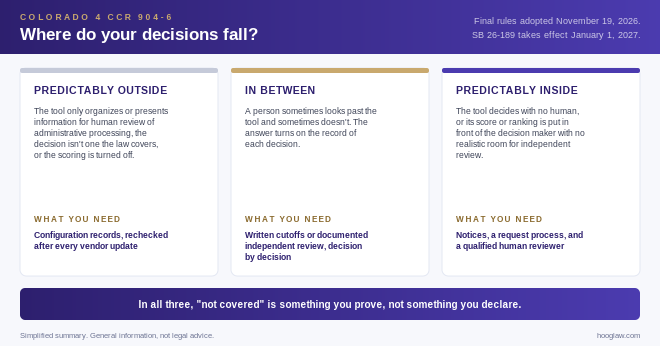
Decisions tend to fall into three groups:
- Predictably outside the rules: the tool only organizes or presents information for human review of administrative processing, the decision isn’t one the law covers, or the feature is turned off.
- Predictably inside: the tool decides with no human involved, or its score or ranking is put in front of the decision maker in a process that leaves no realistic room for independent review.
- In between: a person sometimes looks past the tool and sometimes doesn’t. There, the answer really does turn on the record of each decision.
In all three, “we’re not covered” is something you prove, not something you declare. When a score, ranking, or recommendation about a person is reviewed, filters what the decision maker sees, or makes the decision without a human, the rules presume the tool materially influenced the decision. A sound policy helps only if you can show it was followed in the decision someone asks about. My companion piece, “Colorado’s Final AI Rules: Lighter Notices, a Wider Net,” covers what changed in the rules. This one is about what to do next.
Why the work can’t wait
The rules list ways to rebut the presumption:
- No one looked at the output.
- The decision rested on a cutoff that was documented before the decision, wasn’t derived from, calculated by or dependent on the tool’s output, and was applied consistently.
- The decision maker actually reviewed substantial other relevant information, had the authority, subject matter understanding and time reasonably necessary to do an independent review, and reached a decision consistent with that information.
- The decision went against the tool, or there’s other evidence of independent judgment.
Every one of these is a fact about the decision as it happened.
That’s why you can’t wait. If someone asks in July about a decision made in March, you can’t go back and recreate the February cutoff, the decision maker’s notes, or how long the hiring manager spent on each finalist. Nothing in the rules bars a declaration written later, but I don’t think it will carry the weight of a record made at the time.
Check your own paperwork too. The rules say your marketing, procurement contracts, internal policies and training materials may be weighed in deciding whether the tool’s output was only a de minimis factor. A memo telling recruiters to go with the top-ranked candidates will be hard to explain later.
I hear this all the time: “A person makes every hiring decision.” Often that person is working through hundreds of ranked applicants a week, with no record of what they looked at or how long they spent. That company may be covered without knowing it.
The one almost everyone shares: LinkedIn and Indeed
Whatever your field, whether lending, housing, education or insurance, you probably hire. That makes this the one potential exposure almost every business shares, and it’s easy to miss. Few companies set out to buy an AI system for hiring. They post a job on LinkedIn because everyone’s there, or on Indeed or another job board because that’s where people look for work. Posting a job doesn’t, by itself, bring you under the rules. What matters is how you use the platform: which features are turned on, and what you do with them. If the platform ranks, matches, flags or filters the applicants you see, and you work from that list, you may be using automated decision-making technology without ever having decided to.
When a vendor runs the tool for you or at your direction, and you make the decision using its output, the obligations are yours. That’s Rule 4.3. In the rule’s example, a staffing company uses an automated tool to narrow an applicant pool, and the employer picks from the list. The employer is the deployer.
LinkedIn and Indeed aren’t named in the rules, but the same analysis likely reaches their recruiting products. If you pay for the product, set the criteria and screening questions, and pick from the applicants the platform ranks, flags or filters, you’re looking at or relying on the platform’s ranking or classification of each applicant. Setting the criteria normally won’t make you a developer: a deployer that configures a purchased tool following the developer’s instructions is excluded, unless that activity otherwise fits the statutory definition. The deployer obligations stay with you.
The platforms still matter in two ways. Either one could be a developer, which means it owes you documentation, so get it. Either one could also be a source of the personal data used in the decision, and an applicant who gets an adverse outcome notice and asks for more information is entitled to have each source named when you know it.
Eight things to put in place now
In the order I’d tackle them:
1. Inventory every tool, including the ones you didn’t buy as AI
List two kinds of technology:
- Tools you got to help make decisions: screening, underwriting, scoring, admissions or scholarship software.
- Features built into software you use for other reasons that score, rank, match, flag or filter people. This group is the easiest to miss. It includes job boards and professional networks like LinkedIn and Indeed, and it can include applicant tracking, property management, loan origination and admissions platforms.
What matters isn’t why you got the tool, but what it does in the decision. For each one, note:
- which features are on
- who uses them
- what the decision maker actually sees (a score, a “top match” tag, a filtered list)
- whether anyone reviews the people the tool didn’t surface
Include outside firms that screen before you see anyone, such as staffing firms, background screeners and assessment providers.
Remember who counts. Consumers include employees, Colorado-resident applicants and anyone whose access to, eligibility for or opportunity in Colorado is evaluated in a consequential decision by a business operating here, so the inventory can reach people outside Colorado.
2. Sort each tool into one of four buckets
Each tool falls into one of four buckets, and each needs different work.
It isn’t the kind of tool the law covers. Software used only to summarize, organize, translate, draft, route or present information for human review of administrative processing is excluded. The rules’ example is sorting applications by GPA with no subjective input. Keep records showing the tool doesn’t score or rate anyone, and recheck them after vendor updates.
You’ve turned the scoring off. If the score or ranking doesn’t appear, and doesn’t sort or filter the list, you can show no one relied on it. Hiding the field isn’t enough if the list is still sorted by it.
You use it, but can prove it played only a minor role. Usually that means the decision rested on a written cutoff set in advance, or a person genuinely reviewed other information and made the call. This takes the most work, because you need a record for each decision.
It plays a real part in the decision. Then comply. After an adverse decision, the notice must describe the decision and the tool’s role specifically, including any human reviewer’s part, say so if the denial was automatic, and explain how to get more information and exercise the consumer’s rights. It doesn’t need scores or reasons. For a high-volume step, complying may cost less than the records needed to prove the alternative.
3. Write the cutoffs down in advance
Minimum requirements are often the strongest rebuttal: a required license, work authorisation, or a published minimum GPA. They hold up if the cutoff:
- was documented before the decision,
- isn’t derived from, calculated by or dependent on the tool’s output, and
- is applied to everyone.
A cutoff based on the platform’s own match score fails that test. Date the requirements, keep them with the file and document every exception. If the tool applies a cutoff automatically and the rebuttal fails, the adverse outcome notice must say the person was automatically denied.
4. Design the decision step
If you’re relying on independent judgment, decide in advance:
- who makes the decision
- what authority they have to depart from the tool
- what expertise they bring
- what else they’ll review
Then budget the time, since the rules ask whether they had the time reasonably necessary. If they can show what they reviewed, how long they spent and why they decided, and you’ve documented their authority and expertise, you have evidence for each element. Someone clearing 300 applications a day won’t.
5. Decide where the record lives
Scattered evidence won’t help you. Pick one system and capture what the decision maker saw, what else they looked at, timestamps and a brief reason. The rules spell out the record for human review and tie it to the statute’s three-year retention requirement. I’d use that list and that three-year horizon for all decision records.
6. Fix the paper
Pull your policies, training materials, procurement justifications and vendor contracts, and check how each describes the tool’s output. Rewrite whatever doesn’t match what your people actually do, then make sure practice matches the page. A policy that calls scores ‘advisory only’ and isn’t followed is worse than none.
7. Put the vendor terms in writing
Rule 4.3 lets you contract with a vendor that runs the tool for you to help meet your obligations. Get developer documentation from every vendor on your inventory, and their data sources by name, since the rules presume you know the sources a vendor uses when it runs the tool for you. Ask for help with the 15- and 45-day response deadlines, and for notice before any scoring or ranking feature changes. If a large platform won’t negotiate, keep a dated copy of its published documentation. You can reasonably rely on it unless you actually know it’s materially inaccurate or incomplete. More on that in what to ask your AI vendor.
8. Build the procedures for after the decision
Have these in place even if you’re confident in your position.
Notices. Tell people before the decision that the technology will be used. After an adverse decision, you have 30 days to send a second notice. If the FCRA or ECOA requires you to send an adverse action notice, that notice can serve, as long as it (or a supplement sent with it) explains how to request more information and how to exercise the consumer’s rights.
A way to take requests. After an adverse decision, people can ask for more information, for their data, for corrections and for human review, and responses are due within 10 to 45 days, with limited extensions. Unless you deal with consumers only online and directly, in which case an email address is enough, offer at least two ways to ask, including your website or app if you have one.
A reviewer. People are entitled to human review to the extent it’s commercially reasonable, and you carry the burden of proving it isn’t. The reviewer needs:
- authority to change the decision
- training in accuracy and objectivity, in what the tool considers and in the subject matter
- access to the evidence
- protection from management pressure and retaliation
A qualified outside reviewer under contract can fill the role if you stay accountable, the contract keeps individual decisions free of your influence, and you oversee administration and performance, not outcomes.
And don’t retaliate against anyone who makes a request.
Timing
The statute takes effect January 1, 2027. A federal court order in X.AI LLC v. Weiser bars the AG from enforcing against conduct that occurs through 14 days after the court rules on xAI’s preliminary injunction motion, and how long that lasts depends on when the court rules. Don’t plan around it. The statute’s notice and review rights apply from January 1, and the rules’ detailed requirements apply 20 days after the rules are published.
If you’d like to start with the inventory, particularly the LinkedIn and Indeed accounts your team uses every day, I’m up for a call. You can also see how I handle AI governance and compliance work.
Common questions
Does posting a job on LinkedIn or Indeed bring a business under Colorado’s AI rules?
Not by itself. What matters is how the platform is used: which features are turned on, and what the business does with them. If the platform ranks, matches, flags, or filters the applicants a business sees, and the business works from that list, it may be using automated decision-making technology. When a vendor runs the tool for the business or at its direction and the business decides using the output, Rule 4.3 makes the business responsible for the deployer obligations.
How can a business rebut the presumption that a score or ranking materially influenced a decision?
The final rules list ways to rebut it: no one looked at the output; the decision rested on a cutoff documented before the decision, not derived from, calculated by, or dependent on the tool’s output, and applied consistently; or the decision maker reviewed substantial other relevant information, had the authority, subject matter understanding, and time reasonably necessary to do an independent review, and reached a decision consistent with that information. Going against the tool, or other evidence of independent judgment, can also help. The list is not exhaustive.
Who can conduct meaningful human review under Colorado’s AI rules?
The reviewer can be inside or outside the business but needs authority to change the decision; training in accuracy and objectivity, in what the tool considers, and in the subject matter; access to the evidence; and protection from management pressure and retaliation. A qualified outside reviewer under contract can serve if the business stays accountable, the contract keeps individual decisions free of the business’s influence, and the business oversees administration and performance, not outcomes.
Regulatory status as of November 24, 2026
The Colorado Attorney General adopted final rules under SB 26-189, 4 CCR 904-6, on November 19, 2026. They are not yet in effect.
Before the rules are filed with the Secretary of State, the Attorney General must issue a formal opinion, which the Department has requested. The rules take effect 20 days after they are published. SB 26-189 itself takes effect January 1, 2027.
A stipulated order in X.AI LLC v. Weiser, No. 1:26-cv-01515 (D. Colo.), bars the Attorney General from initiating enforcement for conduct occurring on or before 14 days after the court rules on xAI’s motion for a preliminary injunction, which is due within 28 days after final adoption of the rules.
General information, not legal advice. No attorney-client relationship is created by reading this page.
Legal disclaimer
This page is for general informational purposes only and does not constitute legal advice. The discussion above is a simplified summary of Colorado SB 26-189 and the Attorney General’s rules under it, 4 CCR 904-6, and is not a substitute for a complete legal analysis of your specific situation. Laws and regulations change, and the final rules, adopted November 19, 2026, are not yet in effect. To understand your actual compliance obligations, consult with qualified legal counsel. Nothing on this page creates an attorney-client relationship between you and Hoog Law or Michael Hoog.